
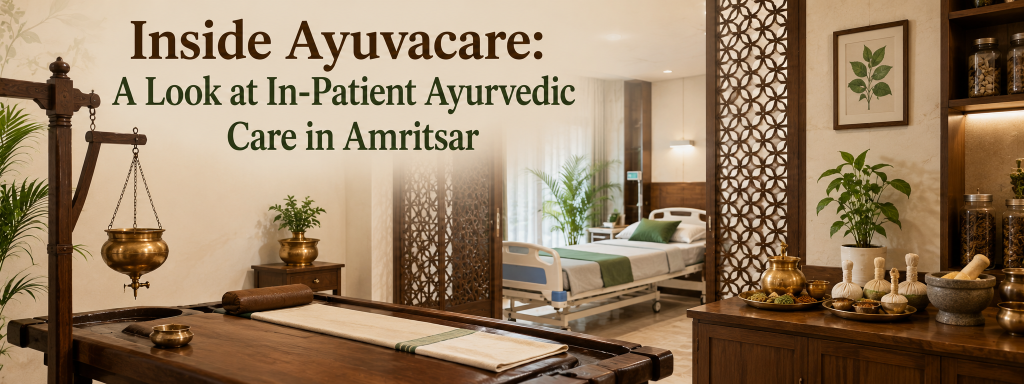
Most people picture two options when they think about Ayurveda: a home remedy, or a one-hour spa massage. What tends to surprise people is that a genuine *Ayurvedic hospital in Amritsar* looks a lot more like an actual hospital than either of those — supervised admission, structured daily protocols, a medical team, and a recovery plan that continues well after the treatment itself ends.
This article is a walkthrough of what that actually looks like inside Ayuvacare — Bawa’s Centre of Modern Ayurveda — for anyone who has been searching for an Ayurvedic hospital in Amritsar and wants to know what to expect before they book a consultation
What Makes an Ayurvedic Hospital Different From a Clinic Visit?
A clinic visit is usually a single appointment — a consultation, maybe a prescription, and you’re on your way. In-patient Ayurvedic care is a different model entirely. It’s built around observation over days, not minutes: how your body responds to a treatment on day one changes what happens on day three, which changes what happens on day seven.
That’s the core reason hospital-style Ayurveda exists at all. Certain therapies — particularly deeper Panchakarma protocols — need consistent monitoring, controlled diet timing, and a treatment team that can adjust the plan daily. That kind of continuity simply isn’t possible in a single outpatient visit.
Inside an Ayurvedic Hospital in Amritsar: What to Expect During Your Stay
Here’s roughly what a new in-patient guest experiences at Ayuvacare:
Arrival and assessment
before any therapy begins, Dr. Arjun Bawa conducts a detailed intake: pulse diagnosis, digestion pattern, current medications, lifestyle history, and the specific concern that brought the person in.
Treatment Rooms at an Ayurvedic Hospital in Amritsar
each therapy uses medicated herbal oils, steam equipment, and traditional tools specific to the procedure being performed that day (oil massage, steam therapy, enema-based procedures, or nasal therapies, depending on the individual plan).
Rest and recovery space
in-patient Ayurveda isn’t just the treatment hour; a large part of the protocol is structured rest afterward, which is why a dedicated recovery space matters as much as the treatment room itself.
Kitchen and diet planning
food is treated as part of the medicine, not an afterthought. Meal timing and content are adjusted daily to match the treatment phase a patient is in.
A Typical Day for an In-Patient Guest
Mornings usually start early, with a light herbal preparation before the main therapy of the day. The main procedure — whichever one has been prescribed based on the individual’s assessment — happens mid-morning, followed by supervised rest. Meals are timed around digestion, not the clock. Evenings are kept deliberately quiet: minimal stimulation, an early dinner, and rest, since the body does much of its repair work during this window.
The exact structure shifts depending on which week of the program a patient is in — preparation, main therapy, or the recovery phase — which is part of why a hospital-style setting matters more than a single spa-style session ever could.
Who Chooses In-Patient Ayurvedic Care in Amritsar?
In-patient care tends to make the most sense for people managing longer-standing lifestyle and metabolic concerns, chronic fatigue, joint stiffness, or stress-related conditions that haven’t responded to a single round of outpatient treatment. It’s also chosen by people travelling from outside Amritsar — including from other cities and abroad — who want a complete, supervised program in one visit rather than scattered outpatient appointments over months.
As always, in-patient Ayurveda is not a substitute for ongoing medical care for a diagnosed condition — it’s best approached as a structured program that complements a patient’s existing treatment plan, decided jointly with a qualified doctor.
Safety, Supervision, and What We Never Compromise On
Hospital-style Ayurveda only works if it’s genuinely supervised — which is exactly the standard bodies like NABH require for accredited AYUSH institutions: qualified BAMS physicians, documented treatment protocols, hygiene and infection control, and clear patient rights and consent processes. The [National Health Portal of India](https://www.nhp.gov.in/nabh-accredited-ayush-hospitals_mtl) maintains information on these accreditation standards for anyone who wants to understand what a properly regulated Ayurvedic in-patient facility should look like before choosing one.
Whichever Ayurveda hospital in Amritsar you’re considering, it’s worth asking directly about the doctor’s qualifications, how daily protocols are documented, and how the facility handles any medical complications during a stay — questions a serious centre shouldalways answer clearly.
Why Patients Choose Ayuvacare's In-Patient Ayurveda Program?
At Ayuvacare, every in-patient plan starts from Dr. Arjun Bawa’s individual assessment rather than a fixed package, and is adjusted daily based on how a patient is responding. This matters especially for patients already managing kidney, liver, or metabolic conditions, where a Panchakarma-style protocol has to be built carefully around their existing treatment, not layered on top of it without coordination.
If you’ve already looked into shorter outpatient therapies, our guide to the Panchakarma centre experience in Amritsar covers what a typical outpatient protocol involves — in-patient care is the deeper version of that same structured approach, for people who need more than a few sessions can offer.
Ready to See It for Yourself?
The best way to understand whether in-patient Ayurvedic care is right for you is a direct conversation with Dr. Bawa about your specific health picture — not a generic package. As always, please continue any ongoing medical treatment and consult your primary doctor alongside any Ayurvedic program.